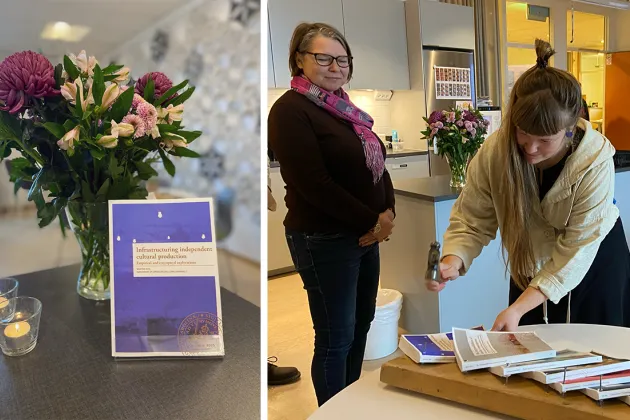


A new doctoral thesis in Service studies from Lund University sheds light on the processes and practices of independent cultural actors sustaining their work despite limited resources and challenging urban conditions.
Independence
This work studies the phenomenon of independent cultural production. Nehl suggests to discuss the idea(l) of independence in a relational sense.
“Being ‘independent’ implies self-determination of cultural production – deciding who to work with, which audience to address or which societal processes to contribute to. But this freedom is negotiated, often through balancing of crucial interdependencies – funding opportunities, public expectations, and urban development agendas” Nehl says. She argues that ideas of the ‘autonomous’ and ‘resilient’ artist risk overshadowing the infrastructural labour hidden in the everyday efforts by these actors.
Infrastructuring
Theoretically, Nehl brings the concept of ‘infrastructure’, from science and technology studies to urban and cultural studies. She utilises infrastructure in a dual sense, not only to describe the conditions that could support cultural production – spaces, funding arrangements, legal frameworks, but to analytically explore the varied practices that enable these conditions. Nehl emphasizes ‘infrastructuring’ as a verb to highlight the ongoing, long-term and often overlooked aspects of cultural production – balancing needs, embedding processes, foregrounding functions, maintaining relations.
Cases
Empirically, the study analyses a diverse set of data which includes archival and policy documents, interviews and observations. It is based on two cases in Europe. At a neighbourhood level, Nehl studies the collaboration of an artist studio collective working together with a municipal housing company. In this relationship she calls ‘service-entanglements’, cultural actors provide activities catering to the neighbourhood, while the housing company keeps working space for these actors affordable. At a transnational level, this work looks at a European network of independent cultural centres. Here Nehl shows how recurring physical network meetings enable experiences of togetherness, nurturing relationships that infrastructure in the long term.
Contributions
This compilation thesis shows that cultural infrastructure is relational and continuously produced collectively by cultural actors. Nehl operationalizes the concepts – ‘embedding’ and ‘foregrounding’ as two practices to understand and stabilize the infrastructuring process.
“Embedding is when cultural actors anchor their work in relation to particular spaces, contexts, and third actors, like collaborating with local housing associations in a specific neighbourhood. Foregrounding then is about strategically making the infrastructuring practices visible. For instance, through event hosting, or participation in policy development. This aids in bringing forth invisible labour, or hidden tensions” Nehl says.
Her focus on these practices situated in todays’ contested contexts, makes her work timely. The thesis importantly calls for critical reflection on cultural production – rather than taking things for granted – and delves deeper into questions on affordability, precarity, temporality, relationality.